The pimps, who used to call themselves the Club of the 40s and, at the beginning of the 20th century, founded the Sociedad Israelita de Socorros Mutuos Varsovia in Avellaneda, a screen for their illegal activities, since they only granted them legal status in that city of metropolitan region of Buenos Aires.
With the connivance of the authorities and the Police, whom they bribed, the Polish ruffians became strong. Forced to change the name of their association due to the bad reputation it gave their country, they renamed it Zwi Migdal, which came to have more than four hundred members after the First World War. Despite the fact that the sources differ, they controlled some two thousand brothels, through which hundreds and hundreds of young people would pass, whom they recruited in villages in their country with promises of work or, acting as false boyfriends, of marriage.
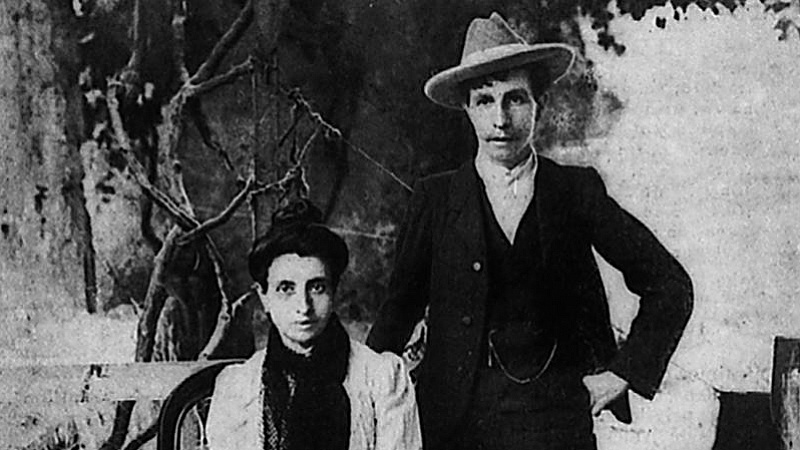
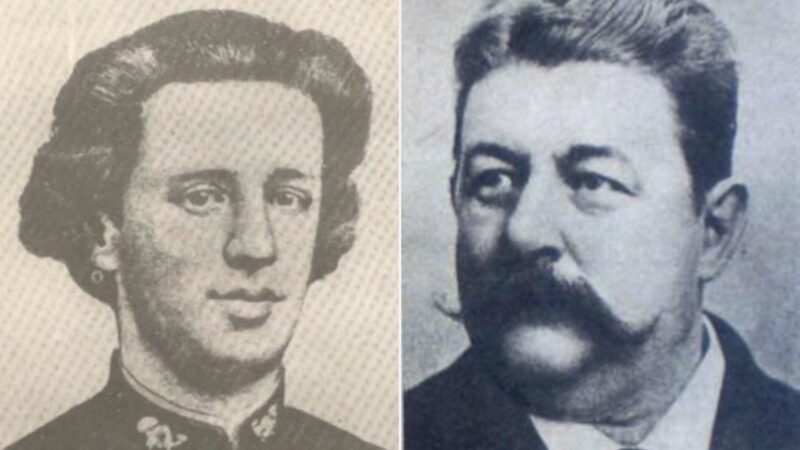
Its first president, Noé Trauman, arrived in the country in 1890. He was 24 years old and although he was Polish, he had a Russian passport since the entire region was under tsarist rule. The only known photo of him was taken by the police 4 years later when they registered him as a "pimp", a name given to those who facilitated the sex trade.
Before the end of that century, Trauman already had his own brothel and knew the Buenos Aires police stations for having been arrested in several street fights. Those were times when the differences between antagonistic groups were still settled by blows. One of these rackets was recorded by the Buenos Aires press in 1897. Some 50 people, including ruffians, their wives, and the ladies of the shops, fought with fists and blows with their sticks at the corner of Corrientes and Talcahuano streets. Among those involved were Russians, Poles, Romanians and half a dozen other nationalities, but the common factor, in addition to the activity, was religion. They were all Jews.
La Mutual had a cemetery in the town of Avellaneda, provided certain health services, offered other benefits, and organized some social activities, as did many of the community entities established in the country. In addition, it had a large headquarters, at Avenida Córdoba 3280, with 620 square meters covered on two floors, with heating and all the modern equipment for the time, where a temple functioned. This was mainly a front for hundreds of ruffians to assemble and set up their network of exploitation. The girls, those who had arrived deceived and those who knew what they were coming for, could not imagine what they would go through.
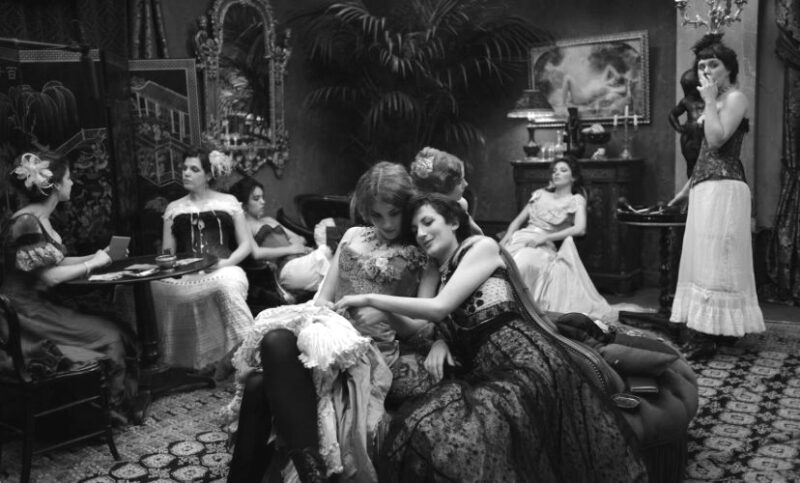
The living conditions were deplorable. They were sex slaves. Exploited, neglected, they devoted their entire existence to sexually serving the clients that crowded the brothels.
The epicenter was in Lavalle and Junín, in the Once neighborhood. There the locals multiplied.
In 1862, riots occurred in brothels where Bartolomé Miter Vedia –son of the nation's president- and Dominguito, Sarmiento's adoptive son, were arrested, among others.
That the history and (bad) reputation of the Zwi Migdal have survived time has not only to do with the extent of its activities. Despite being a huge and established criminal association, the Zwi Migdal was not the only or the most powerful of those dedicated to the white slave trade. The media impact of his fall, the legends that were woven over time, and the ever-present dose of anti-Semitism in society produced the rest.
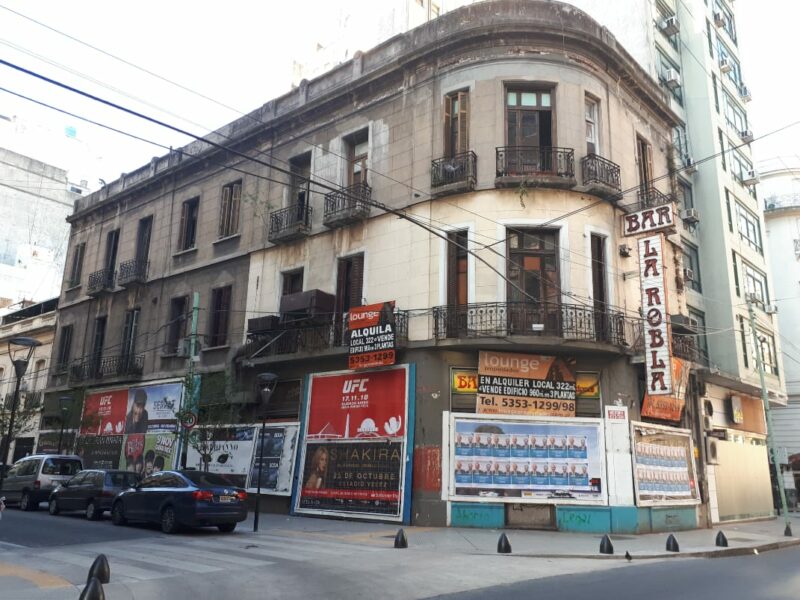
The bar and restaurant La Robla operated here for many years. But prior to this, going up the stairs at passage 725, one accessed the apartment of Simón Brutkievich who, by the end of 1929, was the president of the Zwi Migdal society of ruffians.
The stigma permeated the popular imagination: the Polish Jews who settled in Buenos Aires since the end of the 19th century prostituted their own compatriots. The French, Italians and Spanish did the same, although anti-Semitism amplified the despicable practices of the Jewish mafia.
The subsequent silence of the group itself did not help either, as it classified its criminals as impure. In reality, the fact that they were denounced and rejected sets this community apart from the others —which made up their fellow citizens—, despite the fact that later that dark past became a taboo due to the fear that the shadow of criminal activities of a few undesirables was projected onto all of them.
When they were expelled, the ruffians inaugurated a synagogue and a cemetery, since they had been forbidden to be buried in the Hebrew cemetery. Gerardo Bra argues in the book La organización negra (1982) that, although the exclusion of the impure manifested an act of honesty by the Jewish collective, it would have strengthened them, since they decided to unite and organize, a thesis refuted by other historians.
Una mujer escribió una carta a la asociación contra la trata y la explotación sexual Ezrat Nashim: «Estaba en una de las casas de la Migdal. Mi cuerpo sería ofrecido al mejor postor. Toda mujer que se iniciaba en la vida era cotizada. Y yo lo fui». Sin embargo, durante años las denuncias cayeron en saco roto debido a la corrupción policial. Los tentáculos de los polacos, una mafia surgida como sociedad de ayuda mutua para protegerse entre ellos, alcanzaban a los encargados de velar por los ciudadanos y se antojaba necesario un comisario incorruptible y un juez que sentase a los criminales en el banquillo.
Solo encontraban oposición entre las instituciones judías y entidades como Ezrat Nashim, si bien su labor ha sido cuestionada. Débora Aymbinderow sostiene que tenía una «actitud paternalista y moralista hacia las inmigrantes por las diferencias de clase y de país de origen entre ellas y los filántropos», de modo que intervenían en su vida privada, incluso cuando no había indicios de que la mujer corría el riesgo de ser explotada. La prevención, entendían, pasaba porque se casasen con un judío y encontrasen un «trabajo honesto».
Por otra parte, la lucha del colectivo logró visibilizar el problema, aunque «paradójicamente fue utilizada para reforzar la estigmatización de los judíos». Así, Pedro Katz, director de Di Presse, declaraba al diario Crítica que la comunidad judía argentina llevaba cuatro décadas luchando para «destruir y aniquilar a los repugnantes componentes de la sociedad tenebrosa Migdal», a quienes calificaba como «gavilla de tratantes».
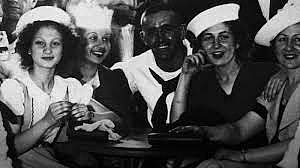
De ahí que en 1906 emprendiese una campaña para eliminarlos, pero reconoce que solo logró expulsarlos. «Nadie los repudia tanto ni los combate más que la colectividad israelita», concluía Katz, dejando claro que todas las comunidades tenían sus redes de trata, más la judía fue la única que renegó de sus proxenetas.
Be that as it may, the plot of the pimps —known as cafishos— would run into a woman who would stand up to them. Raquel Liberman denounced Zwi Migdal for forcing her into prostitution, which would trigger an investigation by commissioner Julio Alsogaray. We have already talked about Raquel and her story on this page.
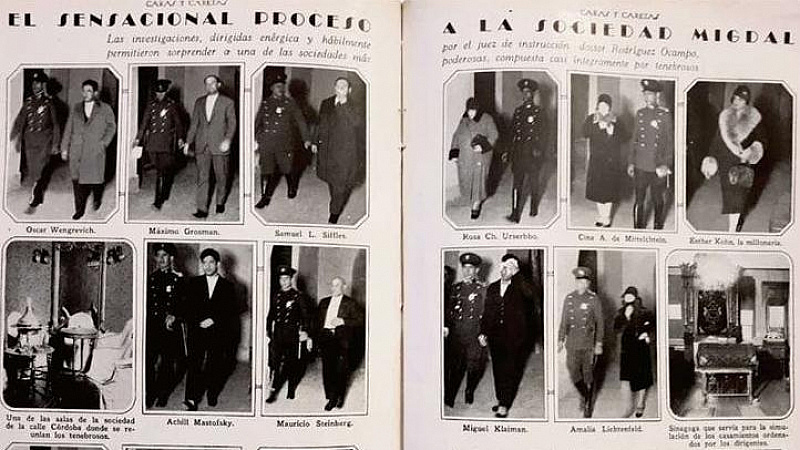
As a result of their investigations, Judge Manuel Rodríguez Ocampo ordered preventive detention for 108 members for illicit association, but they would soon be released due to lack of evidence, except for three of them. Another 334 fled from Justice, for which an international arrest warrant was issued. It was of little use, although the organization would end up dissolving.
Nora Glickman, en el libro The Jewish White Slave Trade and the Untold Story of Raquel Liberman (2000), relata que la redada en la sede de la mafia polaca y el cierre de decenas de prostíbulos tuvo lugar en 1930 tras el golpe de Estado del teniente general José Félix Uriburu. La operación ocupó las portadas de los periódicos y, como resultado de su «valiente acción», publicaron listas detalladas de los nombres de los traficantes y madamas.
The impure cemetery in Avellaneda is a rarity rarely seen in the world and the first that the Jews had in Buenos Aires, currently administered by the Asociación Comunidad Israelita Latina and sealed, in order to avoid it being looked at and classified as living proof. of human exploitation.
In 1907, under the presidency of Trauman, the Zwi Migdal bought a new fraction of land in front of the municipal cemetery of Avellaneda. This sector is the one that is still standing and has given rise to several urban legends. If these men and their wives were characterized in life by flaunting their economic power with an almost obscene display of imported jewelry, furs, and perfumes; At the time of his death, the ruffians decided to alter the ancient tradition of measure and uniformity of Jewish burials, with the placement of expensive and grandiose funerary monuments.
The surface of the place suggests that it would have housed no less than 700 graves. The original records, although incomplete, tell us about the owners of houses of prostitution, their wives and the madams of their premises; but also young children, young students and self-employed. Few are the exploited women who were buried there. Of the thousands of young people who, deceived or expelled by misery in Europe, ended up in Buenos Aires brothels, no traces remained. They disappeared forever after being trafficked, used and discarded.
Legends, hypotheses, ghosts, macabre memories on the one hand and romantic memories on the other are raised as in any story. Supposed conspiracy theories that do not leave aside the subjugation of the poor recently arrived women, the attempt to hide those same memories that hopefully one day can be clarified for the benefit of history and the vindication of the poor, deceived, abused immigrants. , discriminated and exploited. Honoring the memory of all women victims of sexual violence is not only a pious commitment, it is an approach that cannot be postponed today, to learn more about our history and end the trafficking networks that, to this day, continue to be managed. with the same practices.
Compilation of texts from: The chest of history; Nora Glickman, “The Jewish White Slave Trade and the Untold Story of Raquel Liberman (2000)”; José Luis Scarsi, "Tmeiim: the impure Jews"; Everything is history.
 English
  Español
  English (UK)
  Português do Brasil
  Français
  Italiano
  Deutsch
  简体中文
简体中文  العربية
  Русский
Leave a Reply